Water & air · Illustrated explainer 01
Why does a cold glass get wet on the outside?
No leak required. The water begins in the air around the glass, not inside the drink.
Pour a cold drink and look at the glass a little later. Tiny drops can appear outside it. They may join into larger drops and run toward the table. It is easy to imagine that water has somehow moved through the glass. But an intact glass does not need to leak for this to happen. The surrounding air already contains water in a form you cannot see.
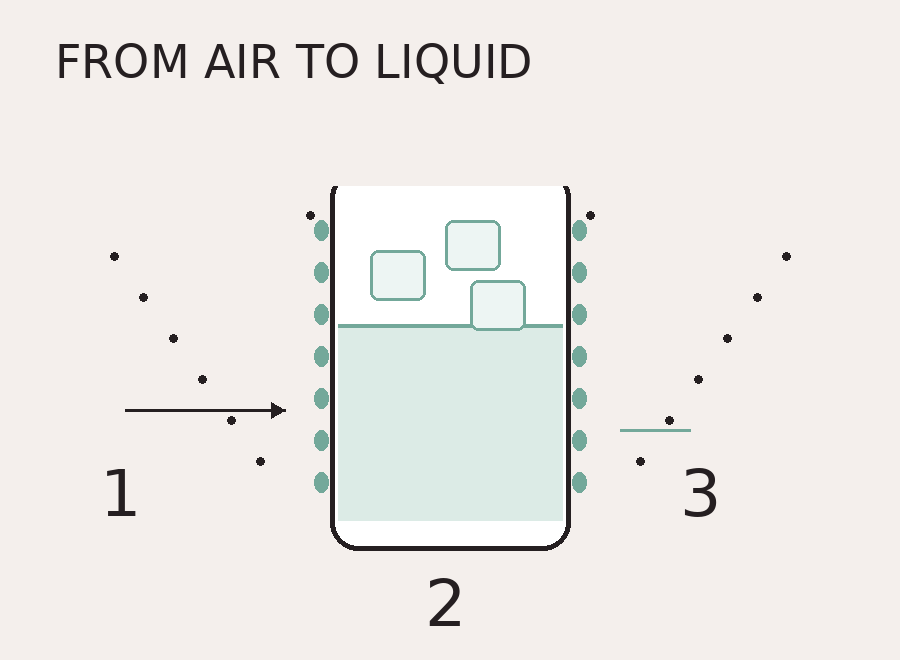
The water changes state
Water vapor is gaseous water. It is invisible, unlike the liquid drops collecting on the surface. When air next to the glass cools to its dew point, some of that vapor can become liquid on the glass. This change from gas to liquid is condensation. The glass gives the vapor a cold surface on which that change can take place.
The dew point is not a universal number printed on every cold drink. It depends on the moisture conditions of the air. The outside surface temperature matters too. A drink that feels cold to your hand is not a measurement of that surface. To understand whether condensation is supported, compare the actual surface temperature with the dew point of the air beside it.
Water inside and outside the glass is the same chemical substance. That does not mean the outside drops passed through the glass. Their route matters.
See the idea in motion
Move the threshold
Can you make the drops disappear?
Room air stays at 24°C. Change one variable and compare the surface with the estimated dew point.
Surface below dew point: conditions support condensation.
How this illustration works
Estimated dew point uses NPL's published Magnus approximation over liquid water, with constants 17.62 and 243.12°C. Air stays 24°C; humidity 20–90%; surface 1–24°C. The ±0.5°C caution band is editorial, not a claim of accuracy. Drops indicate the idea, not a measured amount, waiting time or calibrated condensation test. Values are temporary and not sent or saved.
Why humidity changes the result
Try keeping the glass at 12°C and selecting the two humidity presets. At the fixed 24°C room temperature, the drier setting has a lower estimated dew point. The more humid setting has a higher one. The same glass surface can therefore sit above the threshold in one case and below it in the other. You have changed the surrounding air, not invented a new way for water to pass through the glass.
Then use the warmer-glass preset. Keep the humidity constant and warm only the surface. Notice how the comparison changes. This is the point of the interaction: separate variables that real life changes together. It is not a forecast of how quickly drops will appear or how many milliliters will collect. Air movement, the surface and changing temperatures make real observations more complicated.
A useful explanation, not a damp diagnosis
This physical process helps explain water on other cold surfaces too, including some windows. But a wet surface alone does not prove condensation. A leak, a spill and condensation are different routes to the same visible result. This article explains one route. It cannot diagnose a particular room, wall or window from a drawing.
Next time a cold glass gets wet, ask where the water was before it became liquid, and what cooled it. Those questions are more useful than imagining that every drop came from the drink. The hidden part of the story is the vapor that was already around the glass.
Sources & limits
- NOAA: Sweatin' to the Coldies, condensation on a cold glass
- National Physical Laboratory: dew point and relative humidity
Explanation and media newly authored. No source images copied. No glass, humidity or water volume was measured for this article.