Water & air · Illustrated explainer 06
Same water. More space.
An ice cube can float while a much smaller pebble sinks. The useful comparison is density, not which object has more total weight.
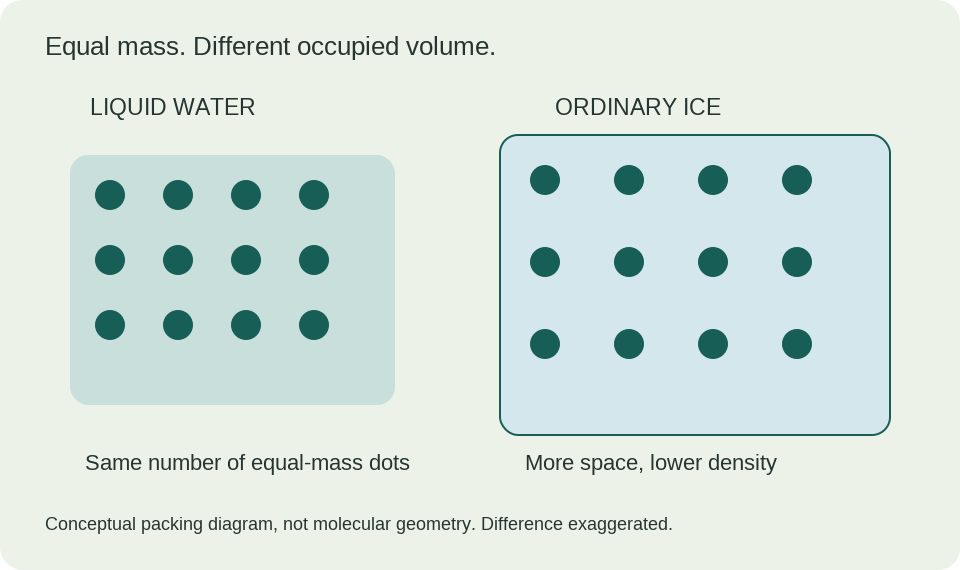
Imagine two samples made from the same mass of ordinary water. One is liquid; the other has frozen into ordinary ice under familiar near-surface pressure. The ice occupies more space. Its water molecules have not become different, lighter molecules. The way those molecules are arranged has changed.
That difference connects a small observation in a glass to two useful ideas: density describes how much mass occupies a volume, while buoyancy describes the upward force from the surrounding fluid. Neither idea says that anything heavy must sink. A large floating block can have more mass than a small sinking object.
Watch mass and space separate
Predict, then change one thing
Make the block bigger. Does it float deeper?
First keep the density ratio at 0.90 and change the block size. Predict whether its fraction underwater changes. Then hold the size still and change the density ratio.
90% of the block volume is underwater in this ideal model.
The density ratios are chosen teaching inputs, not measured ice data. Model: freely floating uniform block at rest; no contact with a container, waves, melting, surface-tension support or trapped-air changes. The fraction refers to volume, not the height of an irregular iceberg. Ordinary ice is less dense than nearby liquid water, but this is not a universal exact iceberg percentage.
Density compares like with like
Density is mass divided by volume. Compare equal volumes and the denser sample has more mass. Compare equal masses and the less dense sample takes up more space. Those are two ways to express the same relationship, not competing explanations.
Freezing a fixed mass of ordinary water increases the space it occupies. The resulting ordinary ice therefore has a lower density than the liquid. This does not mean that every piece of ice has less mass than every quantity of water. A large ice block can contain much more water than a small glass does.
It is tempting to say that freezing makes water “lighter”. Without a comparison, that phrase hides the point. Lower mass per unit volume is the relevant statement. For the fixed-mass comparison here, the mass is held constant while the volume changes.
The molecules are not tiny expanding balloons
A water molecule contains oxygen and hydrogen atoms. The connections within each molecule are different from the hydrogen bonds between neighboring molecules. Ordinary ice has an open, ordered structure shaped by those interactions. Its packing leaves the molecules more spread out on average than in nearby liquid water.
Liquid water still has hydrogen bonds. Its structure changes, and the network can rearrange and distort. That allows closer packing than in the ordinary ice crystal. It would be wrong to draw liquid water as though all intermolecular attractions vanished as soon as ice melted, or to say that each individual molecule swelled into a larger molecule when the water froze.
Our dots illustrate a packing comparison, not the precise three-dimensional bond angles or motions of real water. Water has a rich range of structures and ice phases, especially when pressure changes. This page concerns ordinary ice in familiar conditions, not every possible solid form of water.
Floating is a balance of forces
Water presses on an object from different directions. Pressure increases with depth in a resting fluid, producing a net upward force called buoyancy. Archimedes' principle relates that force to the weight of the fluid displaced by the object. The upward push exists for sinking objects too; having buoyancy does not guarantee that an object floats.
For a freely floating object at rest, the upward buoyant force balances its weight. A block less dense than the liquid can reach that balance with only part of its volume submerged. The submerged part displaces enough liquid for the displaced liquid's weight to match the block's weight.
There is a compact relationship for this ideal balance: submerged volume fraction = average block density ÷ liquid density. A chosen ratio of 0.90 therefore gives a submerged volume fraction of 0.90, or 90%. That is the arithmetic behind the teaching control above. It is not a claim that every real ice sample has exactly that ratio.
Why size and density are different controls
Make a uniform block larger without changing its density. Its total mass increases, so its weight increases. But a given submerged fraction of the larger block also displaces more liquid. Both sides of the balance scale together. In the simple equilibrium model, the fractional submergence stays the same.
Now keep the block size fixed and increase its density relative to the liquid. There is more mass in the same block volume. More of that volume must be underwater to displace enough liquid for balance. The two sliders separate these changes so that “bigger” does not quietly become a synonym for “denser”.
A real iceberg has an irregular shape and may contain air or other material. A percentage of its volume below the surface is not automatically the same percentage of its vertical height. Temperature and dissolved substances also affect water density. We do not turn this block diagram into an iceberg survey or a precise prediction about a particular sample.
What the model cannot tell you
We leave out waves, currents, melting, rotation, contact with the bottom or sides, and small-scale surface effects. The diagram shows selected equilibrium states, not a timed simulation of a cube rising through water. Changing a slider does not reproduce a physical experiment or measure a material.
Most importantly, an explanation of why ice floats says nothing about whether a frozen lake, pond or river can support someone. Floating and structural safety are different questions. This article supplies no thickness rule, load rating or safe-access advice. Do not use it to judge natural ice or to test a frozen surface.
Check your understanding
Does a bigger block have to sink farther as a fraction of its volume?
Not in this ideal comparison. If the block and liquid densities stay the same, the submerged volume fraction stays the same even though the larger block has more total mass.
Does melting destroy every hydrogen bond?
No. Liquid water retains a changing network of hydrogen bonds. Its arrangement differs from the open ordered structure of ordinary ice.
Does “90% submerged” mean 90% of every iceberg's height?
No. The model's percentage refers to volume for a selected density ratio. An irregular shape need not have the same height fraction, and real density ratios vary.
Sources & limits
- USGS Water Science School: water density and ordinary ice
- OpenStax University Physics: buoyancy and submerged volume fraction
- Brini and colleagues, Chemical Reviews: water structure and hydrogen bonding
- European Commission CORDIS: packing and hydrogen-bond flexibility
Original educational explanation and diagrams. No sample was measured, no product was tested, and no exact material density is supplied by the teaching sliders.